
Spanish


¡Únete a nuestro boletín!
X
Media coverage of major corporations—tobacco, pharmaceutical, automotive—in pitched battles with armies of liability lawyers, and sometimes hundreds of millions at stake in damages and punitive awards (and legal costs), leaves the impression that litigation is chiefly a corporate headache. But ask your local coffee shop owner, bodega owner, or mom-and-pop laundry and you may get a very different impression. In America, major corporations can counter the troops of law firms with their own legal forces: in-house counsel, large litigation budgets, and the ability to treat lawsuits as a cost of doing business.
The cost of losing could be ruinous, but so could the cost of fighting and winning.
Not so small businesses. Faced with a lawsuit, even one without merit, a small firm may be forced to settle out of court. The cost of losing could be ruinous, but so could the cost of fighting and winning.
Although no single dataset captures all civil litigation, multiple studies using different methods converge on the same conclusion: small firms bear a disproportionate share of tort costs.
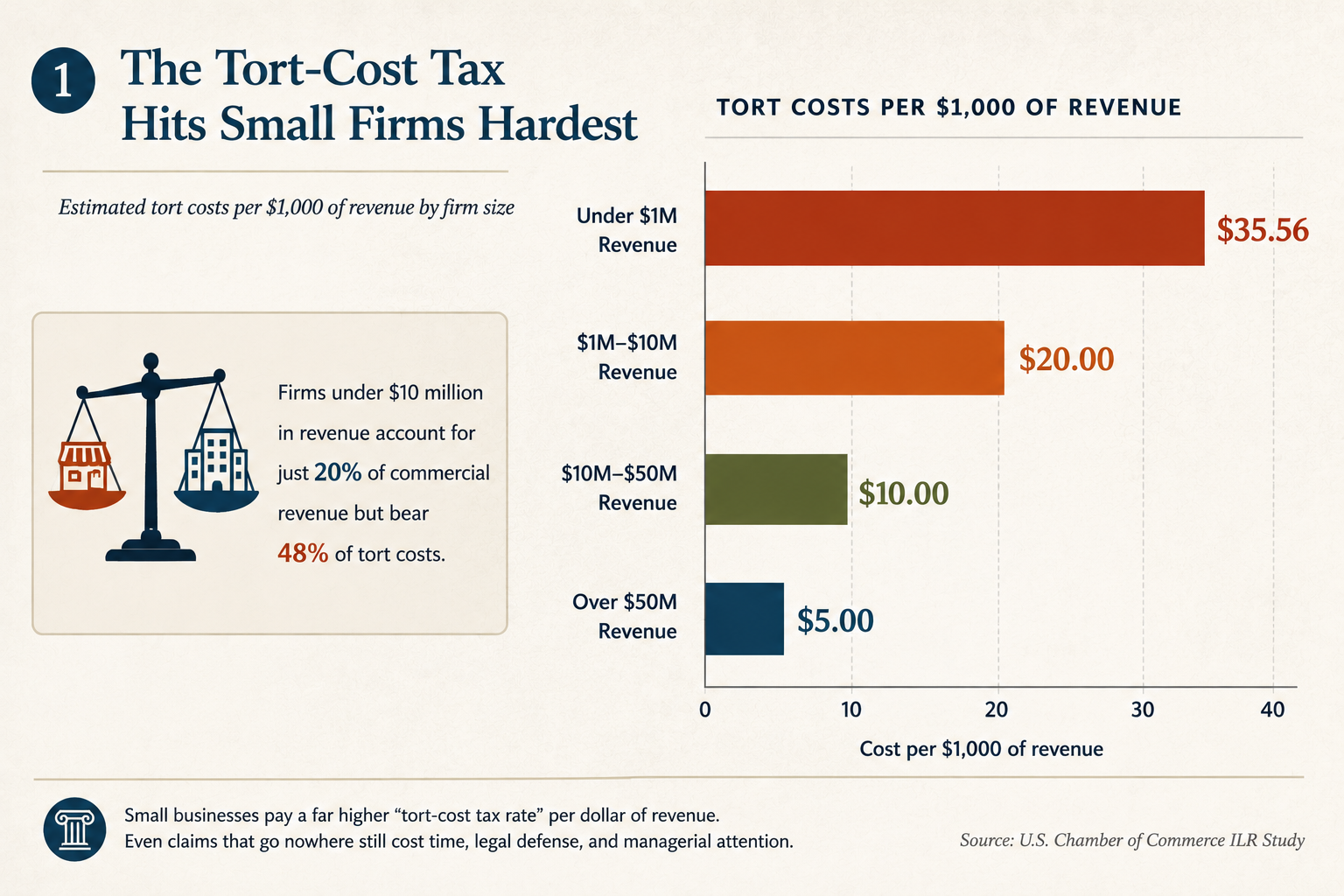
Firms under $10 million in revenue account for just 20% of commercial revenue but bear 48% of tort costs.
A Chamber of Commerce ILR study finds that firms under $10 million in revenue account for just 20% of commercial revenue but bear 48% of tort costs. Cast as an "affordability index" — tort costs per $1,000 of revenue — the disparity is stark: firms under $1 million face an estimated $35.56 per $1,000 of revenue, more than seven times the burden on firms above $50 million.
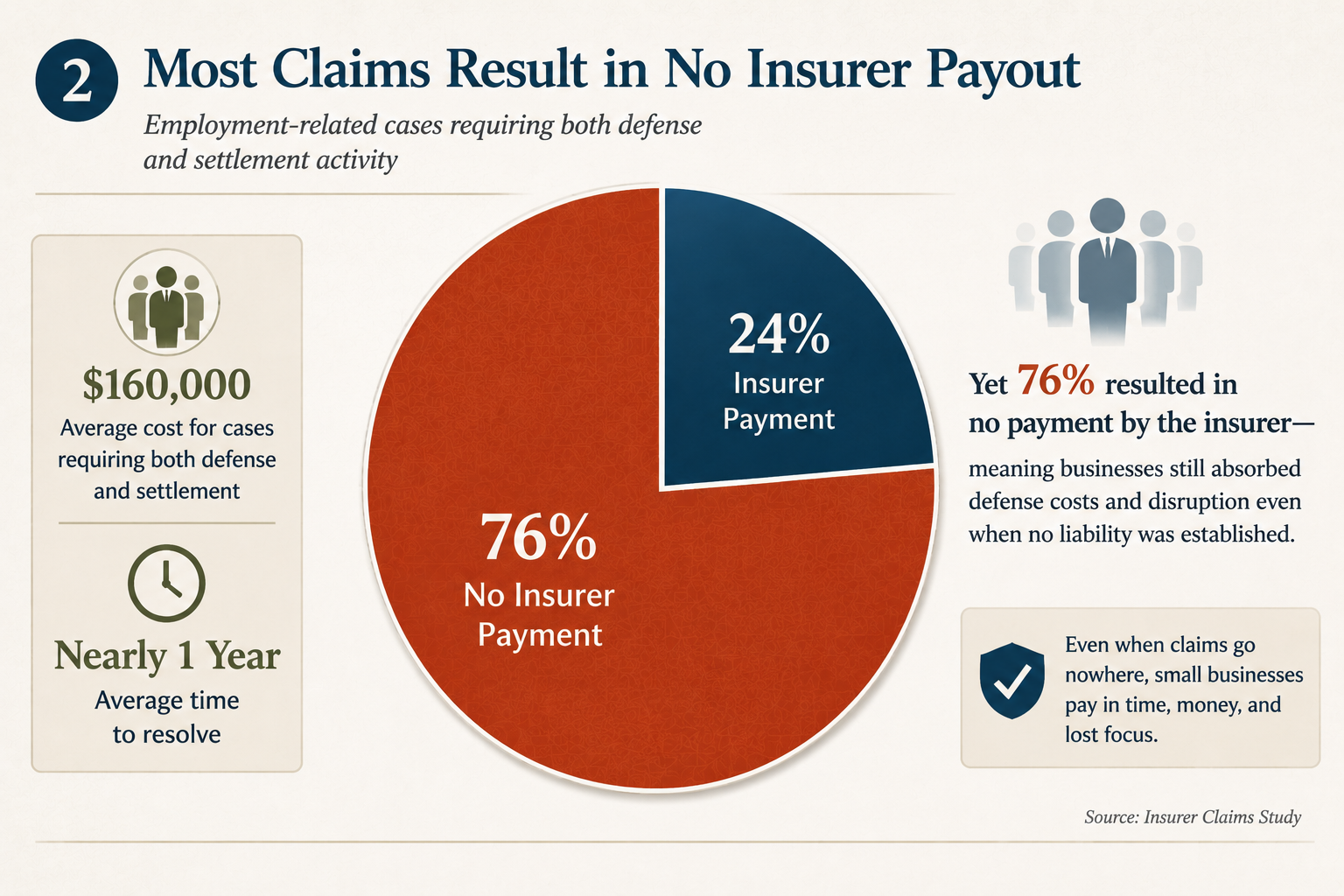
Cases requiring both defense and settlement averaged $160,000 and took nearly a year to resolve.
Employment-related claims are especially burdensome. In one insurer study, cases requiring both defense and settlement averaged $160,000 and took nearly a year to resolve. Yet 76% resulted in no payment by the insurer — meaning businesses still absorbed defense costs and disruption even when no liability was established.
A Small Business Administration analysis of federal filings estimates that roughly 30,000 small firms are pulled into federal litigation each year — and that figure excludes state courts, where most tort cases are filed.
Drawn from interviews with owners who went through disputes: “Legal costs for actual litigation ranged from $3,000 to $150,000,” with approximately one-third under $10,000. They explicitly note owners’ belief that raising prices to recoup costs is often not viable due to competition.
In summary, small firms face a far higher “tort-cost tax rate” per dollar of revenue. Even claims that go nowhere still cost time, legal defense, and managerial attention. Meanwhile, large firms can spend at a scale that dwarfs the annual profits of local businesses.
By filing large number of cases in concentrated jurisdictions, plaintiffs’ firms reduce per-case costs while increasing settlement pressure on defendants.
The litigation pressures facing small businesses are not hypothetical. As the data above suggests, even claims that result in no payout can still impose substantial defense costs and managerial disruption. Federal filings alone draw tens of thousands of small firms into court each year, before accounting for the larger volume of state cases. Within that environment, certain litigation models amplify the strain.
High-volume ADA Title III litigation most clearly illustrates the dynamic. Since 2009, more than 80% of ADA cases have been filed on behalf of “high-volume plaintiffs.” Between January 2009 and April 2023, 18 plaintiffs’ firms each filed more than 1,000 ADA lawsuits, collectively accounting for 44% of filings in that period. Geographic concentration is pronounced: nearly three-fourths of federal ADA cases since 2009 were filed in California, Florida, or New York, rising to 82.7% by 2021, where state-law damages can supplement federal remedies.
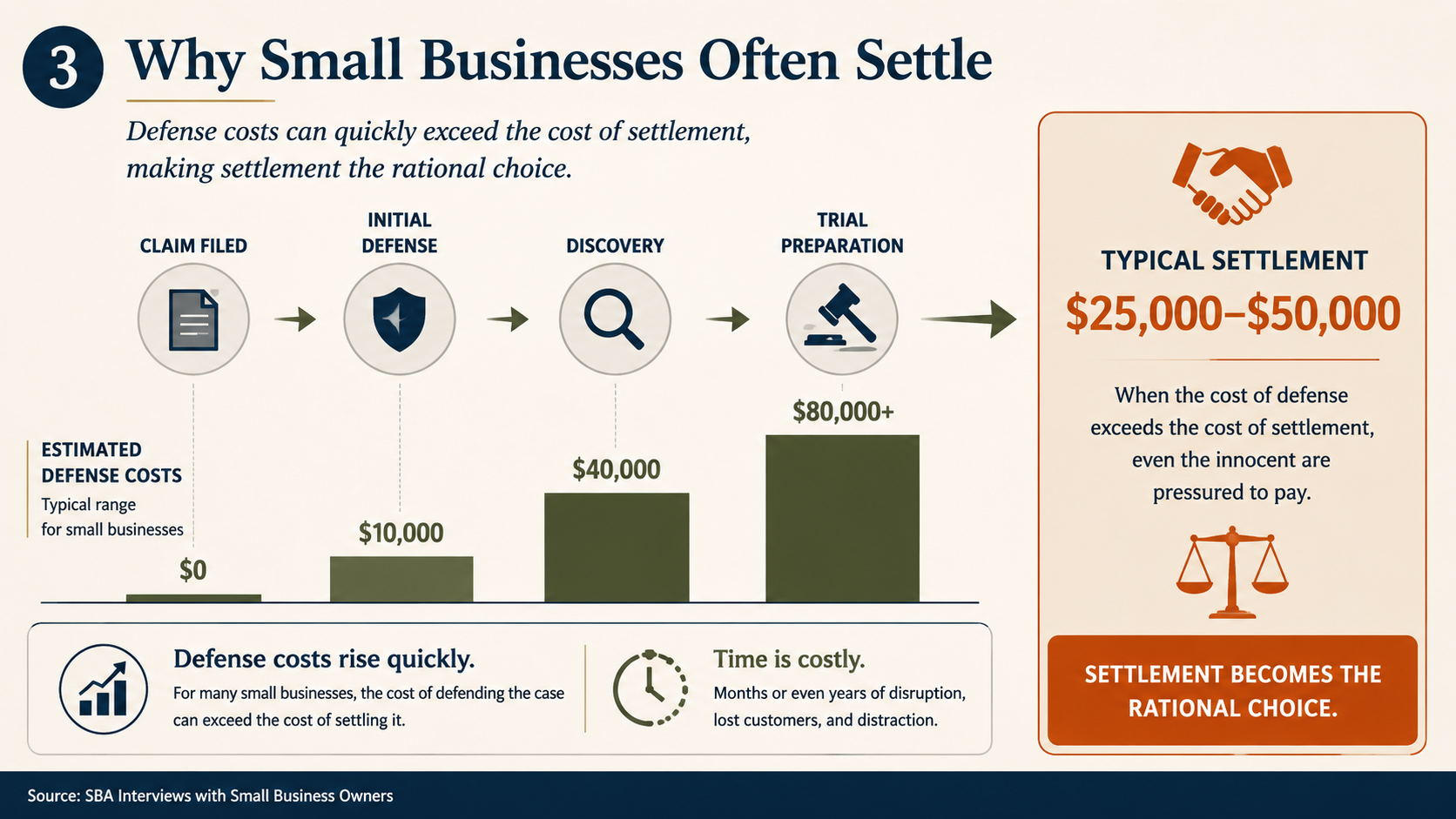
The model relies on scale and leverage. By filing large number of cases in concentrated jurisdictions, plaintiffs’ firms reduce per-case costs while increasing settlement pressure on defendants. For a small business operating on narrow margins, the arithmetic is unforgiving: the cost of defending the case can quickly exceed the cost of settling it. When that imbalance becomes predictable, settlement becomes the economically rational choice, even when the underlying claim is contested.
These figures show a consistent pattern: recurring categories of litigation, significant defense costs even in the absence of a payout, and concentrated filing strategies that disproportionately affect smaller firms.
What kinds of claims most often create this pressure? It is the steady churn of ordinary, repeatable legal exposures—many legitimate in principle but easily exploited in practice.
First are employment-related claims. Wage-and-hour disputes, discrimination allegations, wrongful termination, and harassment claims are common vulnerabilities for small employers, not because small businesses are uniquely malicious, but because they often lack full-time HR departments, compliance officers, and counsel reviewing every hiring and termination decision. As the insurer data suggest, even claims that result in no payout can impose large defense costs and long resolution times—a year in the cited sample. For a small business, litigation becomes punishment.
Second are premises liability and “slip-and-fall” claims. Premises liability suits disproportionately target local establishments. A national corporation may respond with trained risk-management protocols, security footage, and standardized defense strategies. A small business often lacks those resources. Worse, this category is unusually prone to opportunism: a minor incident can become a major claim; a weak claim can still be costly to contest; and the uncertainty of jury reaction creates pressure to settle.
Third are breach-of-contract disputes and small commercial conflicts. These do not always involve “abuse,” but they illustrate the fragility of small firms. A contract dispute that a large corporation can litigate for strategic advantage may be existential for a small contractor, supplier, or franchise owner. The legal system may treat both as “commercial parties,” but the financial reality is radically unequal.
When the cost of defense exceeds the cost of settlement, even the innocent are pressured to pay.
Tort reform is not about shielding corporate giants. It is about ensuring that the law protects rights rather than exploits imbalances. When the cost of defense exceeds the cost of settlement, even the innocent are pressured to pay. A system that rewards volume over merit does not merely tax small businesses — it quietly discourages entrepreneurship itself.
This article is Part 3 of our 5-part series on tort reform. Check out our previous articles below:
Article 1: The Consumer Pays — The Hidden Tax of Lawsuit Abuse
Article 2: Innovation on Trial—How Lawsuits Can Stifle New Ideas
.png)


