
English


Join Our Newsletter!
X
The next great invention may never see the light of day—not because it doesn’t work, but because its creator can’t afford to get sued.
The next great invention may never see the light of day—not because it doesn’t work, but because its creator can’t afford to get sued. Across industries—from autonomous vehicles to medical devices to artificial intelligence—litigation risk has become a routine line item in boardroom calculations. When the possibility of being sued looms over every novel product, firms often choose safer, incremental variations over transformative innovation. The result is slower progress and a poorer society.
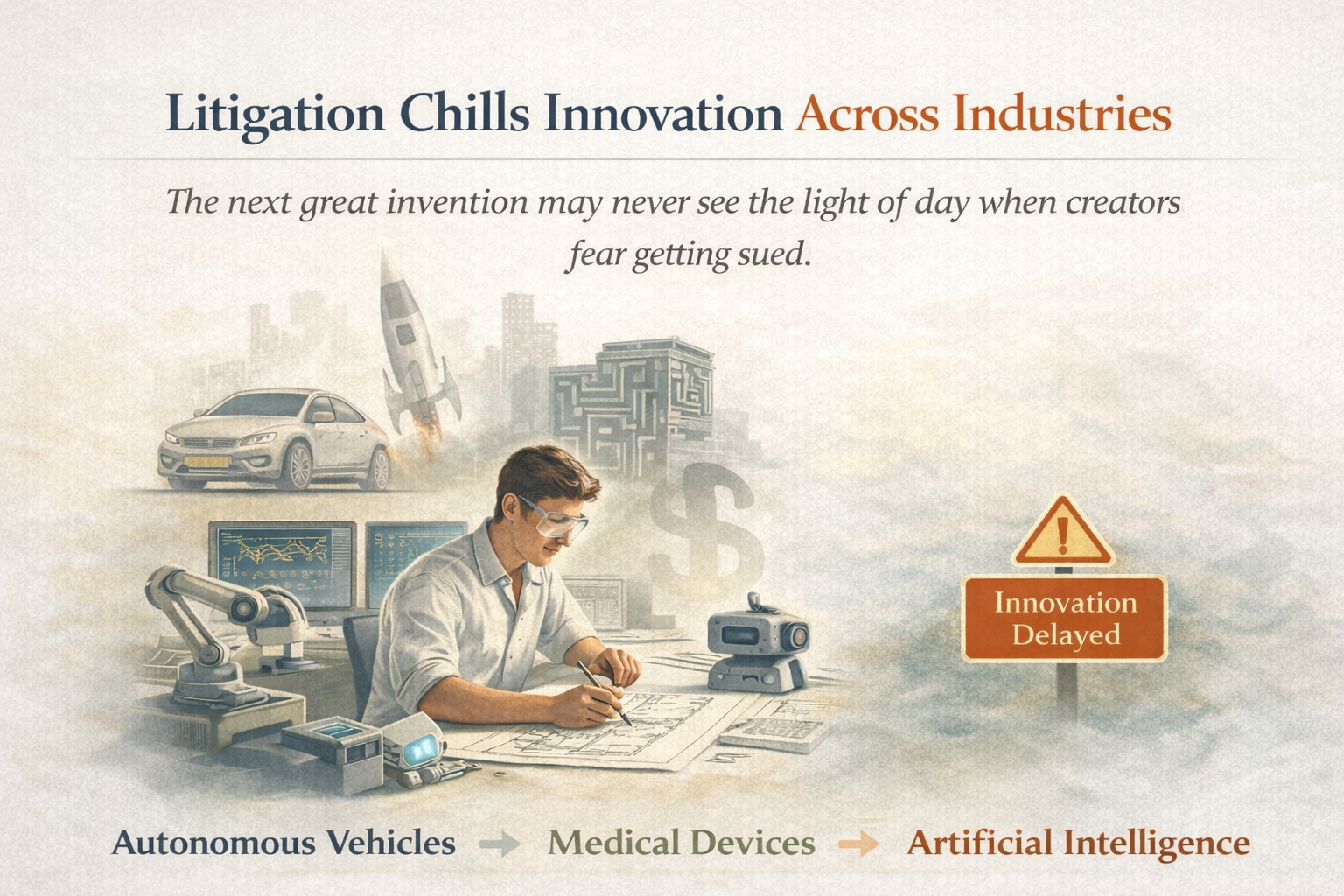
Consider autonomous-vehicle technology. After a highly publicized 2023 incident in San Francisco, California, regulators suspended Cruise’s driverless deployment authority, forcing the company to pause operations. The episode triggered investigations, civil claims, and investor hesitation. Litigation risk was not the only factor at play—but it was inescapable. A single incident nearly froze deployment of a frontier technology that promises long-term safety and mobility gains.
The same legal system that can discipline recklessness can also deter risk-taking and experimentation—the engines of innovation.
As acknowledged in our first article, tort law, properly understood, creates incentives for product safety and accountability. The availability of legal recourse encourages firms to invest in safer designs and rigorous testing. But the same legal system that can discipline recklessness can also deter risk-taking and experimentation—the engines of innovation and advances in the standard of living.
The Double-Edged Sword
Patenting in medical instruments drops by roughly 14 percent in states adopting caps on noneconomic damages.
Cato economists Alberto Galasso and Hong Luo find that patenting in medical instruments drops by roughly 14 percent in states adopting caps on noneconomic (pain-and-suffering) damages. This counterintuitive finding suggests that liability pressure can stimulate safety-related innovation. When exposure declines, so does the incentive to develop certain risk-reducing technologies. That dynamic reflects a long-standing principle of tort law: liability can promote safety.
Against Novel Risks
One challenge lies in how courts treat novelty itself. Scholar W. Kip Viscusi of the Cato Institute notes in Regulation that if liability is biased against “novel risks”—new products whose long-term risk profiles are uncertain—it creates a structural disincentive to innovate. Courts and juries, accustomed to judging safety against established practice, may hold new technologies to standards developed for old ones, even when the new product is objectively safer.
Tort liability assessed against “industry custom” can “tax innovators and subsidize replicators.”
Related is the way tort standards today are adjudicated. Gideon Parchomovsky and Alex Stein argue tort liability assessed against “industry custom” can “tax innovators and subsidize replicators.” Companies that copy existing products benefit from precedent and familiarity. Those that break new ground face uncertainty and the heightened possibility of adverse judgments. Over time, this dynamic favors imitation over originality.
Litigation Delays and Managerial Myopia
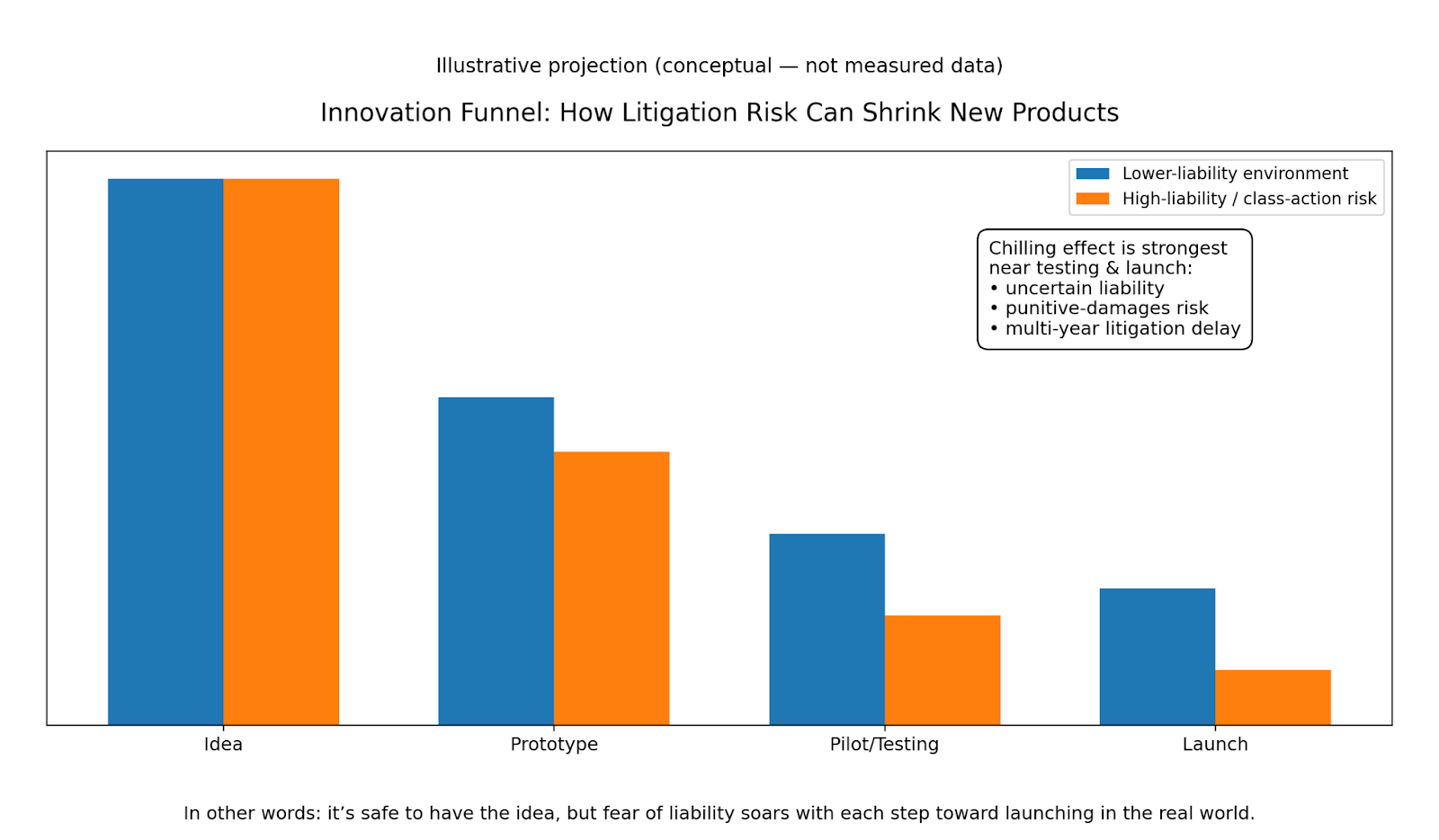
Even when firms ultimately prevail, the drag of litigation itself imposes costs. Product-liability lawsuits can last years, consuming management attention, capital, and competitive momentum. During litigation, companies may delay or cancel product launches to limit legal exposure.
A 2024 National Bureau of Economic Research study finds that product-liability litigation can substantially slow introduction of new products while litigation is ongoing. The impact is often temporary and concentrated in affected product categories. But for those firms, it can be decisive—and visible to competitors and investors.
The Class Actions “Tax” on Innovation
Class-action lawsuits are a distinctively modern risk. They can impose what is called an “expected-cost shadow” over success itself. The December 2021 Journal of Corporate Finance reported that when shareholder class-action risk fell in the Ninth Circuit, innovation output increased significantly. The evidence suggests litigation risk fosters managerial short-termism.
A 2018 study by Columbia Law School’s Blue Sky Blog estimates that the incremental cost of securities class actions associated with successful innovation averages roughly $1.1 million per firm annually —about 3.6 percent of the profit increase attributable to the innovation. Even as a proxy, the figure illustrates the concept: the prospect of being sued for success reduces the expected return on innovation.
Uncertain downstream harms can convert a profitable chemistry into a legal sinkhole.
The effect is especially visible in large-scale litigation. In the case of so-called “forever chemicals” used in firefighting foam, thousands of lawsuits have been filed alleging contamination. As of March 31, 2025, 3M reported more than 7,800 pending cases in SEC filings and announced plans to exit related manufacturing globally. The message to innovators is unmistakable: uncertain downstream harms can convert a profitable chemistry into a legal sinkhole.
The Uncertainty “Tax” on New Technology
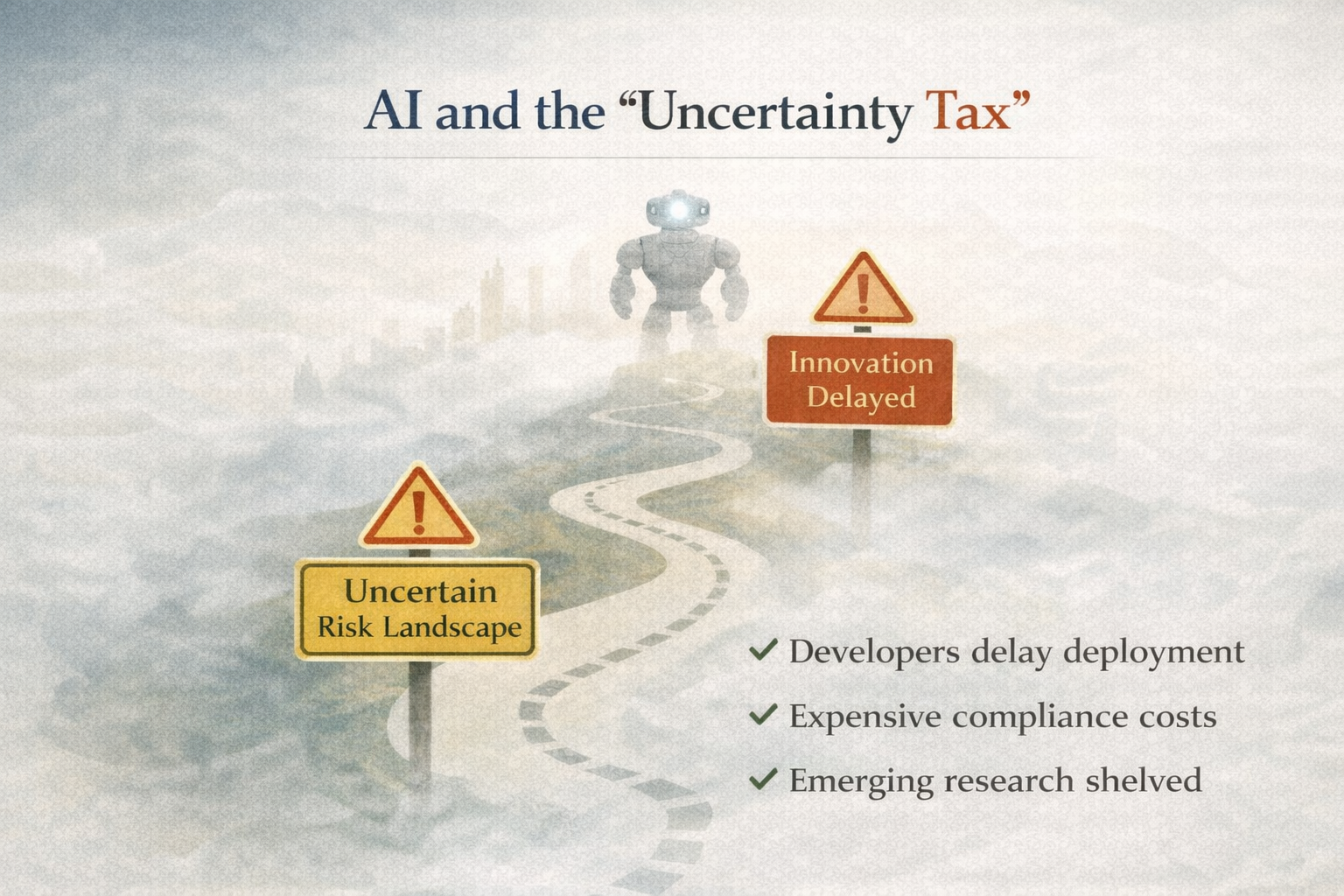
The “uncertainty tax” is particularly acute in emerging fields like artificial intelligence (AI). AI’s potential benefits are vast, but the liability landscape is foggy. A 2024 RAND report noted significant uncertainty about how tort law will treat large-scale AI damages, with outcomes likely varying across jurisdictions. Uncertainty itself imposes costs. Developers may delay deployment, layer in expensive compliance mechanisms, or abandon certain research paths—not because risks are established, but because legal consequences are unpredictable. Without clear precedent, firms must budget for hypothetical future liabilities. That pricing can inhibit entry and deter transformative products.
"Product liability and the tort system generally are designed to foster unpredictable outcomes, and enable a landscape of legalized theft that rewards fraud and undermines justice and the moral right to predictable law." -- Jay Lapeyre, President of Laitram, LLC
Jay Lapeyre, president of Laitram, LLC, a diversified global manufacturer of package sorting and food processing equipment, warns that “Product liability and the tort system generally are designed to foster unpredictable outcomes, and enable a landscape of legalized theft that rewards fraud and undermines justice and the moral right to predictable law. Large companies add bureaucracy, slow innovation, and pass on costs, and small companies and start-ups are smothered in bureaucracy and regulation.”
In the highly visible, surging field of AI, public anxieties can metastasize rapidly—sometimes catalyzed by tragic, highly publicized stories (users falling in love with chatbots)—creating an environment in which plaintiffs’ theories and jury reactions may be shaped as much by cultural panic as by facts. In the 1980s and 1990s, critics of tort excess, such as Peter Huber and Walter Olson, often pointed to dramatic jury verdicts as emblematic of systemic problems. Today, distortions are more subtle.
The modern model frequently involves mass advertising to recruit plaintiffs, consolidation into multi-district litigation, and settlement pressure created by scale. The “verdict” may never arrive in a courtroom. Instead, it manifests as a withdrawn product, a corporate retreat, or an innovation quietly shelved because the risk of one catastrophic outcome is too great.
Dick Weekley, co-founder of Texans for Lawsuit Reform, sums it up, writing “the Texas tort-reform model proves that businesses thrive, expand and innovate when they're freed from the threat of costly, meritless, job-crushing, lawyer-driven litigation.”
Balancing Safety and Progress
When the legal environment makes novelty itself a liability, America risks slowing its own progress.
Pursuing safety at all costs, without tolerating uncertainty in genuinely novel designs, can create a marketplace in which only incremental improvements survive litigation pressure. When the legal environment makes novelty itself a liability, America risks slowing its own progress by placing too heavy a tort tax on the innovators who drive productivity, wealth, and human flourishing.
.png)


