
Spanish


¡Únete a nuestro boletín!
X
 EducationAtlas University
No doctor today can afford to ignore—even temporarily forget—the risk of a lawsuit.
Your doctors and other healthcare professionals are doing both—practicing medicine and playing defense against a perpetual threat of medical malpractice litigation. Economically and professionally, it is unfortunately rational. No doctor today can afford to ignore—even temporarily forget—the risk of a lawsuit and the ever-present possibility of a “nuclear verdict” at trial, sometimes $50 million or more. Why?
Most of the cost is not the occasional jackpot verdict; it is the daily tax on practice.
A major estimate puts the total annual cost of the U.S. medical liability system at roughly $55.6 billion, or about 2.4% of total U.S. health spending. That estimate includes indemnity costs, administrative costs, defensive medicine, and clinicians’ time spent dealing with the legal system. Most of the cost is not the occasional jackpot verdict; it is the daily tax on practice: tests, imaging, consults, and admissions ordered with one eye on legal exposure. Of that $55.6 billion estimate, roughly $45.6 billion is attributable to defensive medicine.
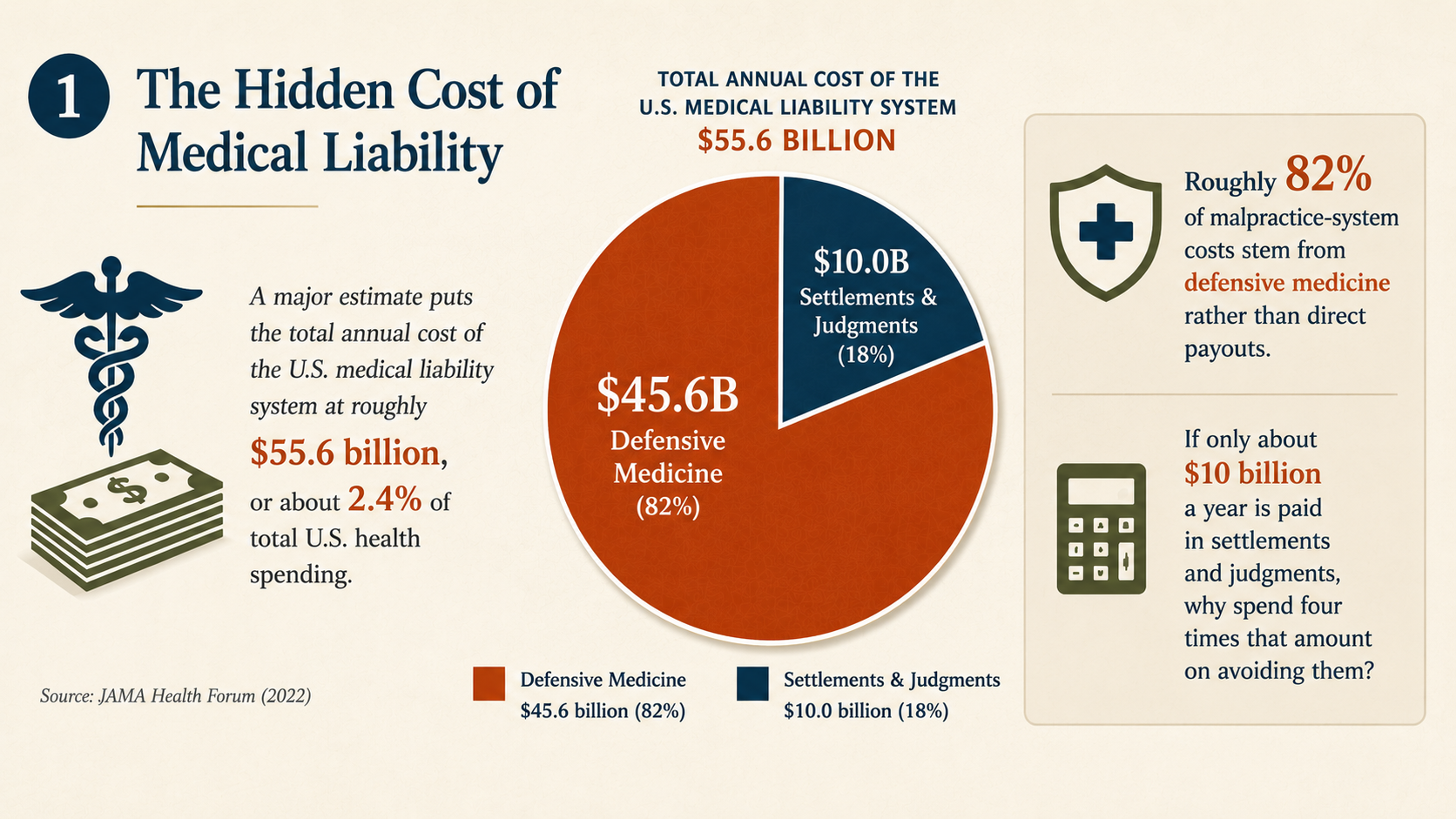
If “only” about $10 billion a year is paid out in settlements and judgments, why spend four times that amount on avoiding them? That is the central paradox of today’s malpractice environment: the incentives and tactics of litigation reshape medical practice in ways that produce enormous secondary costs.
Medical malpractice liability is not an invention of the modern legal profession or the regulatory state. It is a branch of the common-law tort tradition: negligence causing harm must be answered with restitution. But in the United States, malpractice became a recurring national “crisis” in the late twentieth century. Advances in medical technology, rising damages awards, the expansion of contingency-fee litigation, and sharp increases in insurance premiums all contributed. By the 1970s—and again in the mid-1980s and early 2000s—many states experienced waves of premium inflation that drove physicians out of high-risk specialties and triggered calls for tort reform.
It was “rational” for doctors to learn—often early in their careers—to practice medicine with at least one ear attuned to potential courtroom testimony.
But it is not just medicine’s complexity that fuels today’s anxiety. Legal culture also changed. Contingency-fee litigation matured into a scalable business model, enabling law firms to finance expensive cases in exchange for a large share of any recovery. Modern discovery rules and expert-witness battles make defense costly even when the physician prevails. And as jury awards grew larger and more unpredictable, insurers priced that risk into premiums. It was “rational” for doctors to learn — often early in their careers—to practice medicine with at least one ear attuned to potential courtroom testimony.
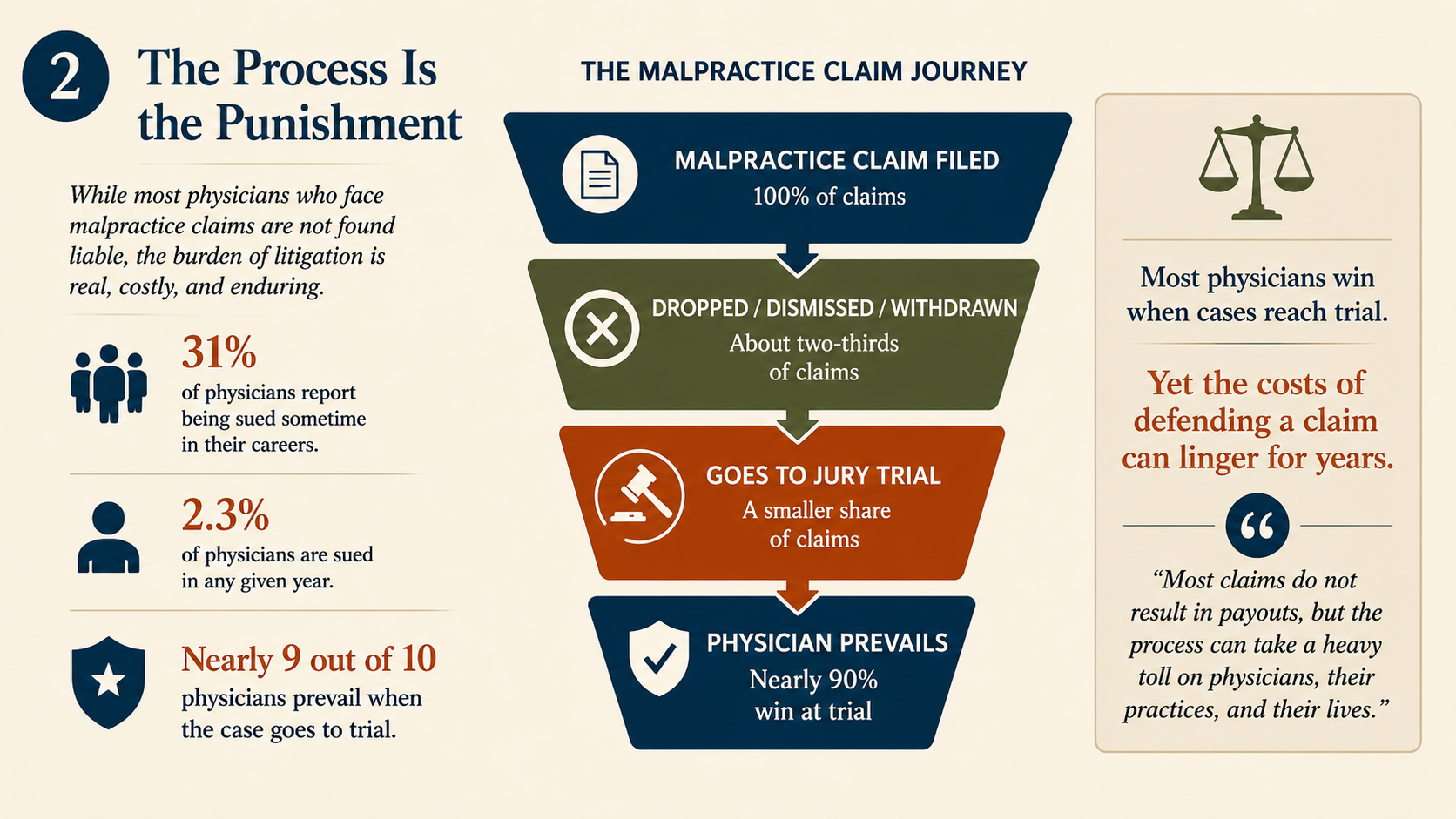
Physicians are sued a lot, but they rarely lose at trial. While only about 2.3% of physicians are sued in any given year, approximately 31% report being sued sometime in their careers, according to the American Medical Association. Most claims do not result in payouts: roughly two-thirds are dropped, dismissed, or withdrawn, and when a case does go to a jury, defendants prevail nearly nine out of ten times.
These costs are embedded in everyday care decisions.
Yet those win-loss ratios conceal the true costs. The process of defending malpractice claims—legal fees, time away from practice, reputational strain, stress—can linger for years and shape future practice decisions long after litigation ends. These costs are embedded in everyday care decisions, from ordering a CT scan that may not change patient management to referring a patient to multiple specialists “just in case.”
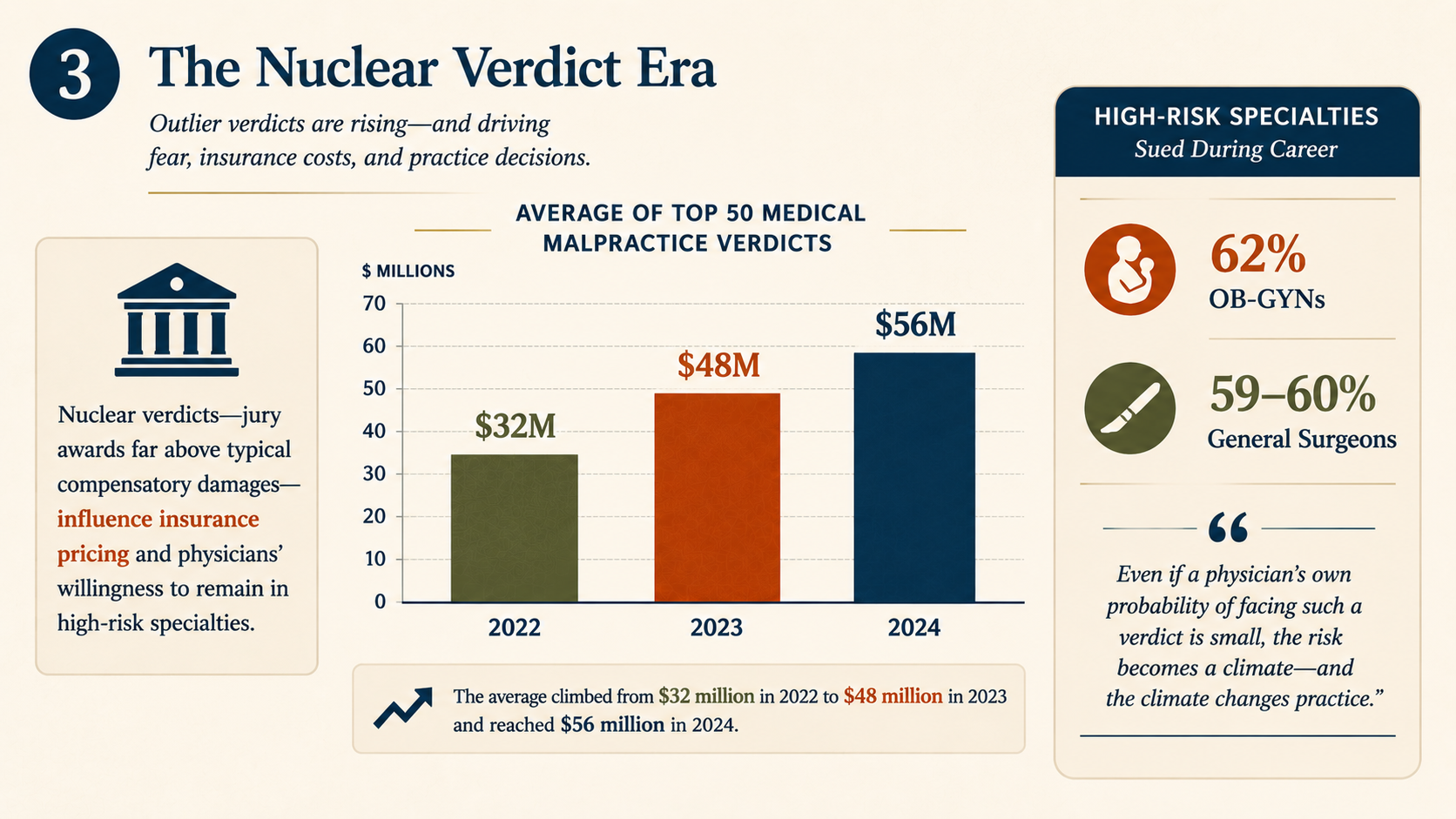
About 62% of OB-GYNs and roughly 59–60% of general surgeons report being sued in their careers.
The distribution of lawsuits also reflects risk and randomness. Certain specialties face far higher exposure. The AMA reports that about 62% of OB-GYNs and roughly 59–60% of general surgeons report being sued in their careers, compared with far lower rates for pediatricians and psychiatrists. Career length matters too: nearly 47% of physicians over age 54 report having been sued, compared with just 9.5% of those under 40.
Today’s malpractice landscape is shaped by what insurers and physicians call nuclear verdicts — jury awards far above typical compensatory damages. The average of the top 50 medical malpractice verdicts climbed from about $32 million in 2022 to $48 million in 2023 and reached about $56 million in 2024, according to a recent industry analysis. These cases are outliers, but they influence insurance pricing, practice decisions, and physicians’ willingness to remain in high-risk specialties.
Concrete examples illustrate the scale of the liability climate. In 2025, a Florida jury awarded $70.8 million to a patient catastrophically disabled after emergency staff failed to diagnose a life-threatening condition. In Missouri, a jury awarded $48.1 million to the parents of a child who suffered severe birth-related brain injury. And in Nassau County, New York, a jury awarded over $60 million in a case involving catastrophic paralysis following an epidural injection.
These awards are dramatic examples of malpractice law at its extreme. They grab headlines, raise premiums, and reinforce physicians’ anxieties. Even if a physician’s own probability of facing such a verdict is small, the risk becomes a climate—and the climate changes practice.
The perceived risk shapes clinical behavior, turning legal risk into a routine variable in practice.
Richard (Dick) Weekley, co-founder of Texans for Lawsuit Reform, describes lawsuit abuse as a hidden “trial lawyer tax”—a drag on the economy that shows up in higher insurance premiums and higher prices for goods and services. Weekley has also emphasized that malpractice litigation pressure produces a second-order cost in healthcare itself: the inflationary impact of defensive medicine. Even when a doctor never faces a lawsuit, the perceived risk shapes clinical behavior, turning legal risk into a routine variable in practice.
Classic hospital-chart-review studies have found that only about 2.5% to 3% of patients injured as a result of negligence ever file a malpractice claim. The overwhelming majority do not sue, and a substantial share of filed claims turn out not to involve negligence.
The cost is not only higher premiums and higher healthcare bills; it is the persistent deflection of medical judgment from reality.
Medical malpractice law began as a rational extension of the common-law principle of negligence: if you harm another through carelessness or falling short of professional standards, you owe restitution. But today malpractice litigation too often rules by fear, altering medical decisions even when no lawsuit has been filed. The cost is not only higher premiums and higher healthcare bills; it is the persistent deflection of medical judgment from reality as physicians incorporate legal risk into clinical calculus.
The system “works” in the narrow sense: most physicians win when cases reach trial. But as legal scholar Malcolm Feeley ruefully observed, “The process is the punishment.”
This article is Part 4 of our 5-part series on tort reform. Check out our previous articles below:
Article 1: The Consumer Pays—The Hidden Tax of Lawsuit Abuse
Article 2: Innovation on Trial—How Lawsuits Can Stifle New Ideas
Article 3: The Small Business Squeeze
.png)


