
Arabic


انضم إلى النشرة الإخبارية!
X
No philosophical issue is more vital, more pivotal, than “free will”—today more frequently termed “volition.” Yes, arguably identity, causality, and consciousness are more fundamental to life—all animal life—but free will (therefore the conceptual level of consciousness, reason) makes us human.
Volition is integral to reason, morality, and personhood. Today’s widespread denial of free will by philosophy and also, overwhelmingly, science, including neuroscience and psychology, undercuts the metaethics of rational morality, substituting some form of subjectivism (e.g., hedonism or altruism), social determinism (upbringing, economic level, race), or religious fatalism (the will of God, the “chosen” for salvation). Or some unarticulated combination of these. With rare exceptions, however, every theory of determinism assumes volition in practice—urging virtue and abjuring vice, rewarding “good” and punishing “evil.”
The philosophical formulation of the idea of free will, and its entry into social discourse, occurred primarily during the 4th and 3rd centuries BC in Greece. Earlier cultures did ponder fate and divine intervention, but systematic debate about whether or not humans possess genuine “agency” emerged as thinkers sought to reconcile moral responsibility with natural law. The discourse evolved, in fact, as a direct counter-response to determinism, shifting the human condition from a matter of cosmic destiny to a subject of ethical accountability and rational choice.
Among seminal early thinkers was Aristotle (384 BC-322 BC), who set the terms, the framework, for the debate in his Nicomachean Ethics, where he distinguished between voluntary and involuntary actions, arguing that praise or blame can apply only to choices made freely and with full knowledge of the circumstances. Later, during the Hellenistic period, Epicurus (341 BC-270 BC) introduced a physical framework for human autonomy by speculating that atoms occasionally undergo a random "swerve" (the clinamen), breaking the rigid chain of cause and effect and allowing for individual freedom. At that time, too, the Stoics, such as Chrysippus (280 BC–207 BC), attempted to harmonize fate with personal responsibility: While external circumstances are predetermined, our internal assent or other psychological reactions remain within our own power.
In the dawning medieval period, the discourse was radically transformed into a dogma of theology. Augustine of Hippo (354-430), who dominates this era, formally coining the term liberum arbitrium (free will) in his treatise On Free Choice of the Will. His aim was to resolve the theological dilemma of how evil could exist in a world created by a perfect God: Moral evil is not caused by God, but results from humans misusing their divinely gifted free will. This helped to lodge the concept of free agency in the bedrock of Western legal, religious, and social institutions for centuries to come. Toward the end of the Eighteenth Century, Jean Jacques Rousseau (1712-1778) used it to fend off the “argument from evil” (why does God permit it?), postulating the gift of free will, but adding that men, born good in “nature,” are corrupted by civilization.
In How Philosophers Change Civilizations: The Age of Enlightenment, I discuss at length how thinkers of the “Age of Reason” (roughly 1685-1815, from the post-scientific revolution to the French Revolution and Napoleon), during which thinkers in many fields fought off the almost universal grip of religious dogma in the name of “Nature,” reason, human autonomy including free will, political liberty under limited constitutional government, and human universalism. I discuss, too, the rise of the anti-Enlightenment in theories of such thinkers as --and, above all, the German Idealist Immanuel Kant and his successors, offshoots, and followers throughout the Western world in the Nineteenth and Twentieth Centuries and until our day in the philosophy of “postmodernism” (with “modernism” a synonym of the Enlightenment). The core and continuity of the counter-Enlightenment over some two centuries was denial that there is a knowable reality and rejection of reason, free will, individuality, reasoned ethics, and limited government enabling free markets. In the social-political sphere, the postmodernist dogma of determinism takes the form of Marxism, sometimes labeled “cultural Marxism.” In ethics, postmodernist determinism takes the form of racial and other collectivist doctrines as explanatory of “interests” and ideologies. (The single best work on the emergence, nature, and consequences today of postmodernism is Explaining Postmodernism: Skepticism and Socialism from Rousseau to Foucault.)
Ever since the Age of Enlightenment, and especially work of Hume and Isaac Newton (1643-1727), the dominant philosophical and also scientific objection to the possibility of free will has been that physics demonstrates the operation throughout nature of cause and effect, admitting of no exceptions. Nobel laureate Francis Crick (1916-2004), co-discoverer with James Watson of the structure of DNA, put the point starkly in his 1994 book The Astonishing Hypothesis: “You, your joys and your sorrows, your memories and your ambitions, your sense of personal identity and free will, are in fact no more than the behavior of a vast assembly of nerve cells and their associated molecules. [Emphasis added.] This assertion of materialism and determinism, in the name of science, leaves no room for human “volition,” except as religion has posited it as a gift from God—a special exemption from the laws of universe—to ennoble mankind.
And this is the rule rather than the exception in contemporary neuroscience. For example, Stanford University neuroscientist Robert Sapolsky (1957-) argues in his 2023 book, Determined: A Science of Life Without Free Will, that free will is an illusion, presenting a comprehensive case that “all human actions are the result of a seamless chain of biological and environmental causes stretching back in time.”
This is not to say that neuroscience is unanimous, here. For example, a 2016 review, “Free Will and Neuroscience: From Explaining Freedom Away to New Ways of Operationalizing and Measuring It,” offers one promising dissent from determinism. The article, by Andrea Lavazza, remains an outstanding review (some 117 references), summary, and integration of the neuroscience literature relevant to free will.
Here, for the sake of “full disclosure,” I will sketch my own position on free will as set forth by Ayn Rand (1905-1982) in her philosophy of Objectivism. Expounded some half-century or more ago, it is a theory that rests primarily on introspective evidence. Rand pointed out that only humans are endowed in full with the conceptual level of consciousness, the level of abstraction based on identification of similarities and differences that are then integrated into a new mental unit, a concept, which is delineated by a definition. Hence, conceptual thought underlies human language.
The conceptual level of thought proceeds from and depends on the automatic input of the evidence of our senses, including interoception, and its automatic integration in percepts. The next level of consciousness, however, is not automatic. Introspectively, we are aware that when we are confronted with the unknown, an implicit question, we can exert the effort to inquire, formulate questions, doubt, ask for evidence, identify contradictions—in short, we can initiate and sustain the conceptual level of consciousness—“thinking.” Or, in the same situation, we can avoid, or consciously evade (Rand said “blank out”) the implicit question, the doubt, the confusion, the curiosity. And that process, not initiated by outside triggers and not dependent upon the content of the situation we face, is experienced as our choice. Sometimes we articulate this: “I’ve got to understand this.” “What is going on?” “Hold on a minute.” “How can that be?” Sometimes we default with the equivalent of “Who knows?” “I just want to do it.” “That’s the way I feel.” “Everyone seems to think so.” “What the hell…”
Rand’s position also featured a philosophical argument. To claim that determinism is “true” confronts us with a contradiction. We cannot claim to have identified, accepted, and spoken the truth if our thought, our “choices,” and our words are determined by forces outside our control: “I can’t help but believe in determinism.”
Rand’s entire argument, of course, refers to the mind, not the brain. Neuroscientists today tend to equate mind with brain. Yes, we have experiences, but these exist on the “phenomenal” not the “physical” level, and, as Crick puts it, are “no more than the behavior of a vast assembly of nerve cells and their associated molecules.” But sensations, emotions, and ideas are real; we can identify, describe, and differentiate them. They can be recorded. They exist in time. All are in the category “consciousness.”
No description of brain structure and processes, however accurate and complete, can fully characterize “volition” because volition is an aspect of consciousness, which, like all consciousness, emerges from brain processes but is a fundamentally different: “[T]hese two—existence and consciousness—are…the irreducible primaries implied in any action you undertake, in any part of your knowledge and in its sum…” Therefore, the question I pose in this essay is: How does our brain, a physical organ subject to causality, mediate this process, this act of volition?
Objectivism’s first response to the doctrine of determinism is to repudiate the equation of “causality” with the “billiard ball” model of causality most famously advanced by David Hume (1711-1776)—and centuries earlier identified by Aristotle as “efficient causality,” one of four types of causality. Aristotle brilliantly integrated the law of causality with the law of identity. An entity is inseparable from an identity, its nature, and how entities act and interact is part of their nature. As Rand put it: “The law of causality is the law of identity applied to action.”
If we affirm the existence of volition based on introspection (and also observation of the responses of others reacting to the unknown, uncertain), then it must be the nature of the human brain to act this way. The cause of volition is the nature of the human brain.
At the time Rand formulated this hypothesis, one might reasonably claim that neuroscience was just coming to understand the operation of our senses and of perception. Understanding of the neurobiology of conceptual consciousness in the human brain, and its volitional nature, lay in the future. True, even then, in contemporary neuroscience, there were individual thinkers—very much in the minority--who made the case for the reality of human choice. But initially this took for the form of philosophical speculation not scientific investigation. Now, Rand’s confidence that one day science would begin to explain how volition is rooted in functioning of the brain has been justified.
Contemporary neuroscience is actively investigating a mathematical framework called the Drift-Diffusion Model to delineate how the brain arrives at decisions. The model does not purport to establish the existence of free will, much less explain volition in the philosophical sense defended here. But it is part of an increasingly important field of research into the neural mechanisms of choice, including the accumulation of evidence, the evaluation of alternatives, the initiation of actions, and their inhibition. I am suggesting that these findings may illuminate how the brain mediates processes that we experience introspectively as voluntary choices.
"Diffusion" refers to a random, “noisy” walk (like a drop of ink spreading randomly through water). In the model, a decision variable is pushed by a purposeful signal ("drift") but disrupted at every millisecond by random neural noise ("diffusion"). Thus, "diffusion" refers to the statistical noise and randomness of neuron firings, not their physical location. This mathematical process is executed by a distributed network of brain regions, diffuse processes in different areas of the brain to explain the sifting and sorting of evidence for competing options: “There is a single continuous variable, representing the balance of evidence for one option over another, that is pushed by a steady drift and disrupted by random noise at every instant, and a decision is registered only when that variable happens to cross one of two fixed boundaries.”
It is plausible to view the "drift rate" as the neurological equivalent of "focus." When a person chooses to focus, look for evidence, and identify contradictions, he is actively increasing the drift rate (the speed and quality of evidence accumulation) toward a reasoned choice. If he defaults or "blanks out," the drift rate flattens, leaving the brain's decision variable to drift aimlessly or succumb to random noise (diffusion).
Many lines of inquiry have initiated and advanced this hypothesis. Although my background is as editor of the neuroscience quarterly, Cerebrum: The Dana Forum on Brain Science, research on the neuroscience of volition was not then extant. Thus, I come to it as a student whose intent is not to critique the theory but to expound it in terms that I hope are accessible to the general reader.
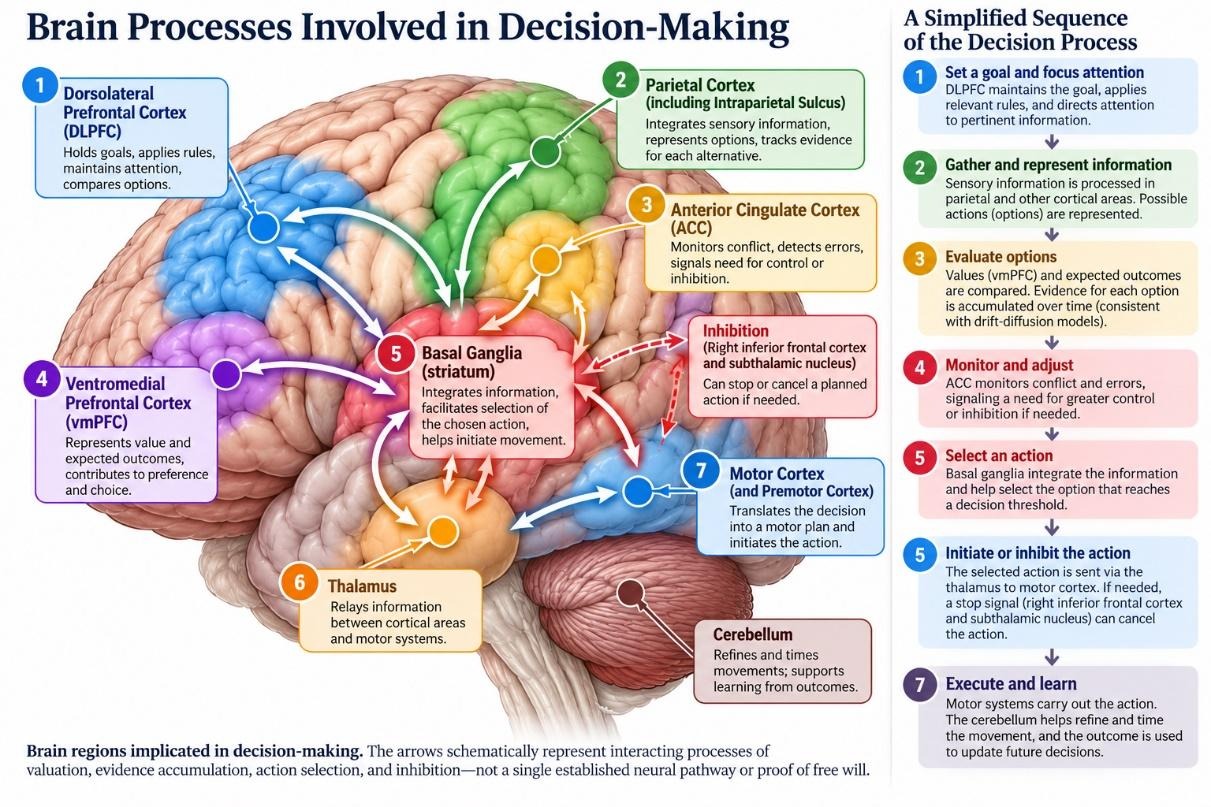
The “gate-keeper.” Our brain steers or manages our voluntary or volitional decisions in the basal ganglia. This section of the brain is the gate-keeper of the process. It tracks a competition, a race, among pools of neurons that represent different options.
The “competition.” The parietal cortex of the brain is where these competing neuron pools/options ramp up or, to put it another way, increase their firing rates or “wide-band gamma activity.” Specifically, the neuron pools increase their firing rate and also inhibit the neurons in other pools to suppress those competing options. Monitoring this competition, or race, the basal ganglia reacts when neural activity representing one option crosses a critical electrical threshold and the “gate” opens: the sensorimotor cortex executes that volitional action.
The referee. The basal ganglia does not function here entirely in isolation. If a decision is “ambiguous”—the race among the competing neuron pools/options is too close—the subthalmic nucleus can act as an emergency brake. It does this by raising the require threshold for opening the gate and, in effect, delaying a decision until more “evidence” is available.
The Contestants. We now reach the question evident all along. What inputs from the brain contribute to the respective strengths (firing rates) of the competing neuron pools/options? If there is a race among neuron pools, what factors contributes to the speed of each? The answer is that in the case of volitional decisions both reasons and internal desires contribute. (If, however, these are overwhelmed by external, outside triggers, the decision no longer is volitional.)
The Equalizer. But, of course, there are many reasons and internal desires relevant to each option. The brain is able to standardize the impact, the contribution, of each variable by translating widely different variables (considerations) into a common neural “currency” or standard of value. Apples with apples, oranges with oranges. How important is the taste of option A versus the healthiness of option A? Both of these are reduced to a commensurate “currency.”
The Integrators. Meanwhile, the ventromedial prefrontal cortex and the orbitofrontal cortex integrate these sensory inputs, memories, and immediate desires into one calculation of each option’s “subjective value.” And this translates into the strength, the firing rate, of each neuron pool/option. At the same time, the ventral striatum evaluates how much physical and mental effort each option will require versus the expected reward: another input into the accumulating neuron pools/options. And finally, the orbitofrontal cortex acts as a scale, weighing positive feelings against negative ones to contribute to the final preference.
The Judge. Is that it, then? Not quite. Apparently, new evidence indicates that even after the brain has carried out its stepwise, diffused, but ultimately integrated process of using sensory input, memories (information, ideas, reasons), and desires to compare options and is preparing voluntary action, we retain a conscious capability in the subthalmic nucleus to cancel or veto that action up to 200 milliseconds (one-fifth of a second) before we take it. That is, the early brain activity is the "ramping up" of the neuron pools/options; our conscious veto power proves that the ultimate boundary-crossing into decision remains under our control.
Here is a key to the brain anatomy of “free will” as understood up to this point:
A few “take aways.” Voluntary choice is not a single, instantaneous exertion of our “will,” not like a flash of lightning, “out of thin air,” with no context like a miracle. It arises within us, from our desires and reasons. Prof. Lavazza, cited above, quotes neuroscientist Stefan Bode that free “decision-making draws upon a rich history of accumulated information, manifested in preferences, attitudes and motivations, and is related to the current internal and external environment in which we act. Complete absence of context is impossible” [My emphasis]. Put it another way: Our choice to “focus” is not the same at age 14 and age 40. Lavazza, a neuroethicist, draws the startling conclusion that we might “create a quantitative index…of the degree of freedom of each subject….”
A volitional decision engages more than half-a-dozen different regions of the brain, connected but not contiguous, which may operate simultaneously or through time (often measured in milliseconds). A volitional decision, therefore, is a stepwise process: neuron pools representing options actively compete (even inhibiting other pools), accumulating relevant inputs that have been “processed” in other brain regions. A voluntary decision has a beginning (when we encounter and are aware of uncertainty), a middle (when our brain accumulates inputs represented by activation of neurons), a climax (when one pool reaches the basal ganglia’s threshold of electrical activity), and a result (releasing the electrical potential to initiate action)—unless a higher level (conscious) intervention overrides, vetos, that result.
Our choices are not “free” because they are uncaused--influenced by no mental context, biased by no cumulative experience. They are free because on every occasion they arise anew, afresh; they are rooted in our own mental contents of every stripe; and they are initiated (or not), driven (or not), and ultimately affirmed (or not) by a conscious act of focusing the mind, an act weighted with no specific content, only awareness of the equivalent of “So, what now?”
Science has only begun to explore how our brains give rise to the conceptual level of our consciousness (including our choice to exercise it or not). What is evident, now, is that its operation engages diverse regions of our brain in distinctive roles through time and calls on an array of existing mental contents. Like all of nature, the physical process is quantifiable and the mathematics complex. Neuroscience comes to this task with vast, exquisitely refined knowledge of the mind, which after all constitutes our entire direct experience of our brain’s functioning. The gulf between our ability to characterize the capabilities of the human mind and our ability to correlate them with processes in the brain is a measure of the magnitude of the challenge still facing neuroscience.
[i] “Reason is the faculty that identifies and integratesthe material provided by man’s senses. It is a faculty that man has to exerciseby choice. Thinking isnot an automatic function. In any hour and issue of his life, man is free tothink or to evade that effort. Thinking requires a state of full, focusedawareness. The act of focusing ones consciousness is volitional. Man can focushis mind to a full, active, purposefully directed awareness of reality or hecan unfocus it and let himself drift in a semiconscious daze, merely reactingto any chance stimulus of the immediate moment, at the mercy of his undirectedsensory-perceptual mechanism and of any random, associational connections itmight happen to make.”
[ii] An intriguingside note for the era of AI: “DDMs are afascinating intersection of stochastic calculus, statistics, and systemsneuroscience. Further, DDMs have recently become integral in discussions aboutmachine learning, sometimes as an architectural component and sometimes as adynamical pattern that trained networks reproduce on their own.”
[iii]This is an intriguing analogy, but the drift rate technically represents therate of evidence accumulation, not the exercise of volition itself. Attentionand cognitive control can affect decision processes, but we cannot simplyequate drift rate with volitional focus. Indeed, the decisionthreshold itself may be a particularly interesting variable for volition:people can adjust how much evidence they require before responding.
[iv] “The basal ganglia are a subcortical group ofinterconnected nuclei involved in mediating action selection within cortex. Arecent proposal is that this selection leads to optimal decision making overmultiple alternatives because the basal ganglia’s anatomy maps onto a networkimplementation of an optimal statistical method for hypothesis testing,assuming that cortical activity encodes evidence for constrainedgaussian-distributed alternatives.”
[v] “Consider, for example, a monkey offered one raisinversus one piece of apple: behavioural evidence suggests that the animalchooses by assigning values to the two options. But where and how values arerepresented in the brain is unclear. Here we show that, during economic choice,neurons in the orbitofrontal cortex …(OFC) encode the value of offered andchosen goods.”
[vi] “…we used functional MRI to scan healthy participantswhile performing a task in which incentive motivation, cognitive, and motordemands were varied independently. We reasoned that a common motivational nodeshould (1) represent the reward expected from effort exertion, (2) correlatewith the performance attained, and (3) switch effective connectivity betweencognitive and motor regions depending on task demand. The ventral striatumfulfilled all three criteria and therefore qualified as a common motivationalnode capable of driving both cognitive and motor regions of the dorsalstriatum. Thus, we suggest that the interaction between a common motivationalsystem and the different task-specific systems underpinning behavioralperformance might occur within the basal ganglia.”
[vii] This comprehensive paper explicitly details the 200 ms window and formulates the hypothesis that the role of free will is notto initiate an action, but to consciously permit or veto it before the motor cortex triggers physical movement.
[viii]The experiment is important evidence of the brain's capacity to interrupt anaction already in preparation. It does not, by itself, prove philosophical freewill.


