
English


Join Our Newsletter!
X
 EducationAtlas University
Entrepreneurial Brushstrokes on a Global Canvas: A Review of James Jameson's Capitalist at Large: Reflections of an International Entrepreneur
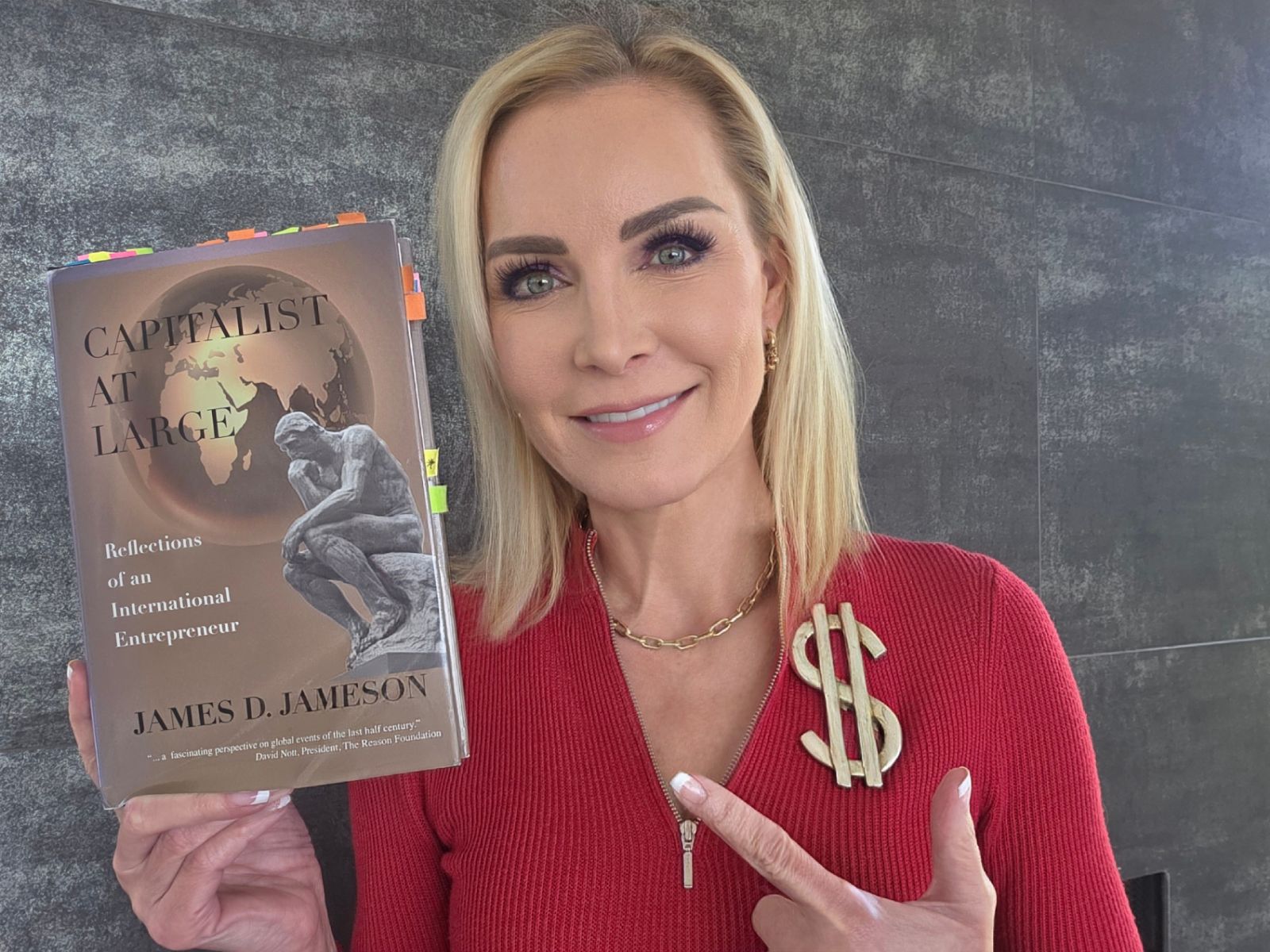
There is a certain kind of person—rare, restless, and possessed of an almost gravitational pull toward the unknown—who does not merely observe history but walks directly into it. James Jameson is that person, and Capitalist at Large is the remarkable record of a life spent perfecting what he calls “the art form for my life, going into politically risky countries without established credit markets and making new businesses work.”
By seventeen he was traveling solo through Singapore, Hong Kong, Bangkok, Delhi, Kandahar, Kabul, Tehran, Beirut, Cairo, Athens, Rome, and Paris on money he had earned himself.
The book opens with an image that sets its pioneering tone. At age seven, young Jameson stood daily before a giant world map his father had mounted on the sleeping-porch wall, neck craned, hours spent in imagination—the Congo, Lake Baikal, the Gobi Desert flickering before him like promises. It is a portrait of the entrepreneurial mind before it knows itself: hungry, curious, undaunted by scale. By twelve he was at boarding school in Switzerland. By seventeen he was traveling solo through Singapore, Hong Kong, Bangkok, Delhi, Kandahar, Kabul, Tehran, Beirut, Cairo, Athens, Rome, and Paris on money he had earned himself.
Like the iconic exchange in The Fountainhead by Ayn Rand, Jameson never asked who would let him, but rather who would stop him. The pattern was established early: Instead of waiting for permission or perfect conditions, he demonstrated a willingness to take risks to pursue knowledge, achievement, and adventure.
As an entrepreneur, those risks included selling helicopters in Indonesia and turning a tenfold return into a major agricultural venture in the Middle East, building farm after farm for Saudi princes. Later he plunged into post-Soviet Poland, Russia, Vietnam, and China, often in places where the very concept of private enterprise and individual initiative had nearly been extinguished.
And sometimes those risks threatened catastrophic consequences. When his California-based drainage company, LIDCO, faced a union strike at the very moment he owed $400,000 to the bank, he thought: “Oh, my God, not now. This could bankrupt me.” It was ironic, for all the union rhetoric about protecting “the little guy,” it was the unions that had teams of strategists and lawyers and massive resources at their disposal. Jameson realized that in reality, that “little guy” was him.
Rather than folding, he used his linguistic facility to get up to speed on Spanish, with which he listened, proposed solutions, and put the matter to a vote—winning over his workers by treating them as rational actors capable of recognizing their own self-interest.
The book's most vivid chapters unfold across the post-Cold War wreckage of the Soviet empire. Jameson arrived in Moscow just days after the Berlin Wall fell, braced for the fearsome superpower he'd been told existed, and found not the anticipated “socialist lion” but rather “a half-blind alley cat with a crooked tail and broken teeth.” In a meeting, when then-President George H. W. Bush declared Russia “open for business,” Jameson replied with unvarnished truth: “Mr. President, there is no spirit of entrepreneurship in the Soviet Union.”
Decades of communism had extinguished that entrepreneurial spirit, and Jameson watched the consequences up close—including the near-catastrophe of a helicopter that burst into flames in Murmansk minutes after he disembarked.
Decades of communism had extinguished that entrepreneurial spirit, and Jameson watched the consequences up close—including the near-catastrophe of a helicopter that burst into flames in Murmansk minutes after he disembarked. “Of course, terrible accidents could happen anywhere,” he reflected, but “the post-Soviet region had shown itself to be an accident waiting to happen in lots of other ways as well, from under-secured nuclear stockpiles to environmental catastrophe.”
But this brush with disaster didn’t deter Jameson’s entrepreneurial brushwork on the global canvas. Nor did exchanges with unreconstructed socialists deter his passionate evangelizing on behalf of free markets. In a memorable meeting with a former foreign minister of Vietnam, who railed against capitalist exploitation, Jameson retorted: “Central economic planning is so inefficient that there is no surplus value left to exploit. You take the full value of labor and squander it on inefficiencies, demeaning your workers and robbing them of their possibilities for consumption. Besides, the workers don’t really own the means of production when the companies are controlled by an authoritarian central government.”
Jameson's account of the “entrepreneurial spark” being suffocated under communism is among the most powerful arguments in the book. He watched it happen in real time, across multiple countries and cultures, and his conclusion is devastating: “The entrepreneurial spark had been suffocated under decades of central planning, while the financial incentives to succeed had been stripped away in the name of egalitarianism.” Egalitarianism, he shows, does not produce equality—it produces shared poverty and a ruling class quietly looting the treasury.
Capitalist at Large is also, unexpectedly, a spiritual memoir—Jameson’s restless intellect drove him through the Torah, the Talmud, the Bhagavad-Gita, the Koran, the writings of Aristotle, Spinoza, and Nietzsche, and annual retreats at a Benedictine monastery in France. To Jameson, this spiritual quest doesn’t represent a repudiation of self-interest, but its extension: “I believe we all had an obligation to pursue our own happiness. We inherited life ‘for free.’ We also inherited the answer books that could help us get through life happily ‘for free.’”
For Jameson, those answer books include the great fictional work of Ayn Rand. He writes of his great respect for Rand’s Objectivist philosophy, and his embrace of its core insight: that individuals who are free to pursue their rational self-interest—so long as they do not harm others—produce the most broadly beneficial outcomes.
But to Jameson, benevolence—as a self-interested value—needs to be a part of that mix: Individuals must also see themselves as part of their families and communities, “and extend their self-interest to include those groups as well.”
But to Jameson, benevolence—as a self-interested value—needs to be a part of that mix: Individuals must also see themselves as part of their families and communities, “and extend their self-interest to include those groups as well.” His desire to see a society in which “tolerance is a virtue” would align him more closely with the open Objectivism espoused by The Atlas Society, as opposed to the more narrow view embraced by the closed-Objectivism camp.
Ayn Rand, writing to her friend DeWitt Emery, president of the National Small Business Men’s Association, had this to say about Atlas Shrugged: In my new book, I glorify the real kind of productive, free-enterprise businessman in a way that he has never been glorified before. I present him as the most heroic type of human being.” A favorite dismissal tactic of Rand’s critics is to say “it’s just a novel,” as if the entrepreneurial heroism presented in fictional form was itself fictional.
But Jameson’s Capitalist at Large puts the lie to such fallacious reasoning. Though it’s as engaging as any novel, it’s a real life retelling of one man’s career seeking out opportunity and creating value. More than a business memoir, it is a dispatches-from-the-field confirmation of everything Rand argued about the relationship between freedom, creativity, and human flourishing—written by a man who spent decades testing those propositions against the hardest possible evidence. Jameson’s life is proof that the entrepreneur is not merely an economic actor but a civilizational one: someone who, by following his own vision into the unknown, creates possibilities that would not otherwise exist.
In The Fountainhead, Rand reminds us: “Throughout the centuries there were men who took first steps down new roads armed with nothing but their own vision.” In Capitalist at Large, Jameson takes us on that journey with him. From the boy imagining the distant regions depicted in atlases—he grew into an Atlas himself, who went to all corners of the world, and made something there.

.png)

