
Arabic


انضم إلى النشرة الإخبارية!
X
Class actions are often described as a tool of consumer justice. In practice, however, they frequently function as a settlement industry.
How many readers have received emails or letters claiming they were “harmed” by a corporation? Perhaps your privacy was compromised, you were overcharged a few dollars, or a disclosure was inadequate. The message is usually vague, but the solution is clear: you are invited to join a class-action lawsuit.
Class actions are often described as a tool of consumer justice. In practice, however, they frequently function as a settlement industry in which lawyers receive millions while the supposed victims receive pennies, coupons, or nothing at all. What began as a mechanism to make justice possible for large groups of small claimants has evolved into a system that often manufactures mass “victims,” monetizes trivial harms, and extracts settlements through sheer scale.
This is not an argument against justice. It is an argument against a system that too often fails to deliver it.
Class actions addressed a real problem. When thousands or millions of people suffer small harms (say a $5 overcharge), individual lawsuits are often impractical. The cost of litigation would exceed the potential recovery, leaving wrongdoing unchallenged.
Courts developed procedures allowing claims to be aggregated into a single lawsuit. After the 1966 revision to Rule 23 of the Federal Rules of Civil Procedure, class actions became a major feature of American law. In theory, this mechanism allows courts to address widespread misconduct efficiently while compensating those harmed.
When harm is real, measurable, and widely shared, the system can work. But much of the modern class-action system functions very differently.
From the perspective of class-action lawyers, however, low participation is not a problem—it is the business model.
One revealing fact about class actions is how little interest consumers show.
The Federal Trade Commission (FTC) examined consumer class action settlements and found that the median claims rate was 9 percent, while the weighted mean was only 4 percent. When settlement notices are delivered by email (increasingly common), the average claims rate drops to about 3 percent. Nor do these consumers bother to object to the action or deliberately opt out of it. They totally ignore it. The FTC found that opt-out rates averaged around 0.01 percent, while objections were roughly 0.0003 percent.
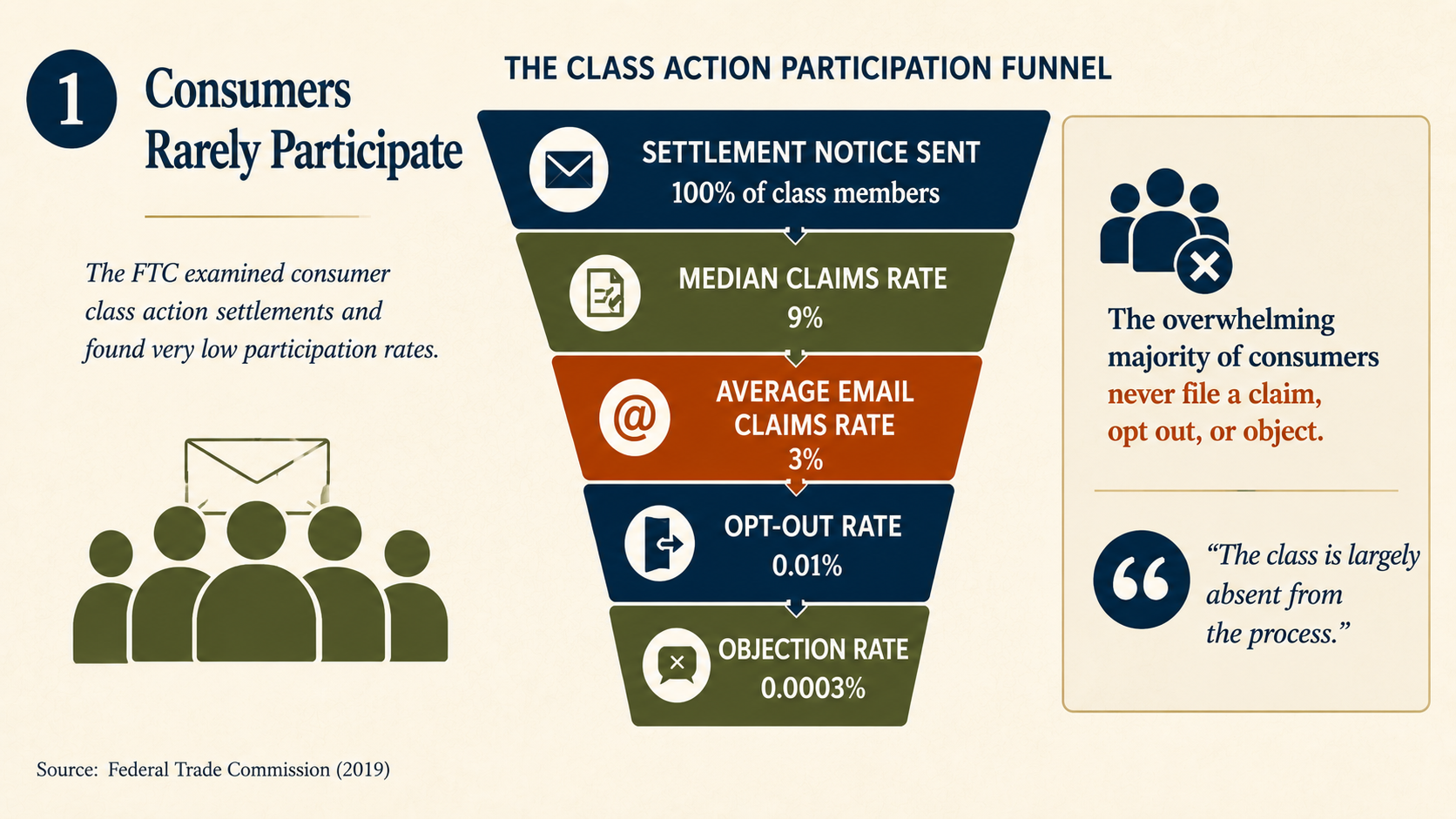
In other words, the overwhelming majority of people never file a claim. The reasons are obvious: the harm is often trivial, the compensation minimal, and the process time-consuming. Many consumers decide that pursuing a few dollars is not worth it.
From the perspective of class-action lawyers, however, low participation is not a problem—it is the business model. The lawsuit can proceed regardless of how many consumers participate, and the settlement is negotiated largely between lawyers on both sides. In short, the class (supposed beneficiary) is largely absent from the process.
A privacy lawsuit involving Google illustrates this system in practice.
In 2022, Google agreed to a $62 million settlement in a class action involving allegations about location tracking. The class included roughly 248 million people. Reuters reported that attorneys in the case received $18 million in fees.
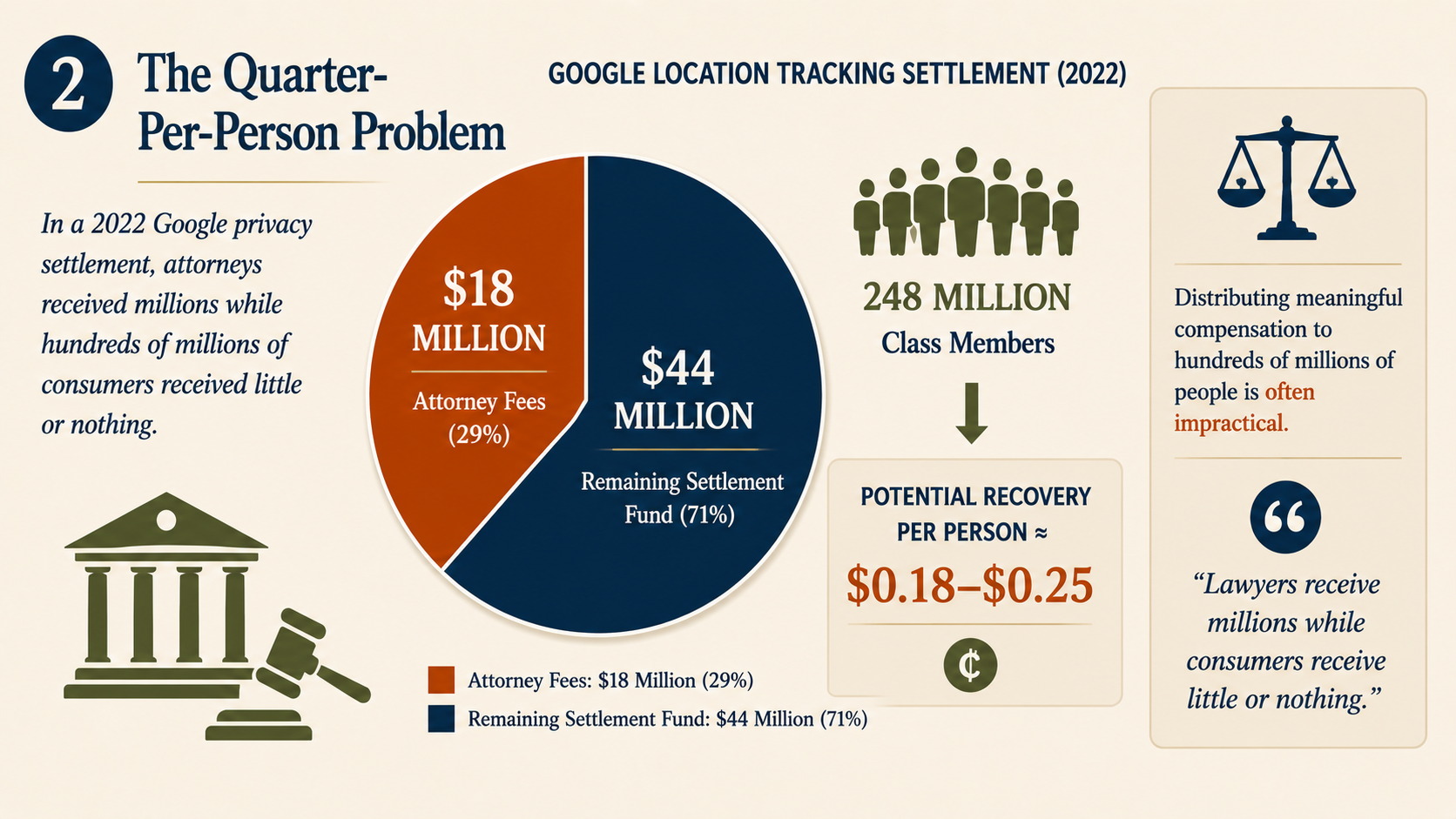
Distributing the remaining funds to hundreds of millions of individuals would have been costly. Instead, much of the money was distributed through a mechanism known as cy pres, in which settlement funds are directed to third-party organizations deemed related to the lawsuit's subject.
The result is familiar: lawyers receive millions while the consumers receive little or nothing.
The use of cy pres distributions further distances settlements from the individuals supposedly represented.
Some settlements show how distant class actions can become from genuine compensation.
In so-called coupon settlements, class members receive discounts on future purchases rather than cash. The defendant company effectively transforms the settlement into a marketing promotion, encouraging customers to buy from the same company that “harmed” them.
Congress attempted to address this problem in the Class Action Fairness Act of 2005 (CAFA), which requires courts to scrutinize coupon settlements and ties attorneys’ fees to the actual value of coupons redeemed rather than their face value.
One frequently cited example involved Duracell batteries. In that case, critics noted that while consumers received coupons worth relatively little in total redemption value, attorneys sought fees exceeding $5 million.
The use of cy pres distributions further distances settlements from the individuals supposedly represented. Borrowed from charitable trust law, the doctrine allows funds to be redirected when direct distribution is impractical. In class actions, however, it often diverts settlement money away from consumers and toward nonprofits, universities, or advocacy groups.
In one case, 3.3 million claims were submitted for a product that had sold fewer than one million units.
Class-action settlement has become so predictable and lucrative that it has been co-opted for pure fraud.
Reuters reported in 2024 that administrators and lawyers faced a surge of suspicious claims in class-action settlements. In one case, 3.3 million claims were submitted for a product that had sold fewer than one million units. Across settlements in 2023 alone, more than 80 million potentially fraudulent claims were identified.

When a racket becomes reliably profitable, criminals exploit it.
Class action tends to trivialize the meaning of harm.
If you charge that your Congressman “is like Hitler,” you whitewash Hitler. The analogy is extreme, but so is a deeper consequence of class action: it tends to trivialize the meaning of harm.
When technical violations (privacy disclosures, labeling disputes, or minor billing errors) trigger large lawsuits, the concept of injury becomes diluted. Genuine victims of serious wrongdoing are rhetorically grouped with people who are “harmed” because a website’s cookie disclosure was inadequate.
Businesses, meanwhile, incorporate litigation risk into pricing, compliance systems, and product design. These costs fall on consumers through higher prices and fewer choices. Large corporations can absorb these risks, but smaller companies often cannot.
As a result, the class-action system can function as a barrier to entry—one more factor that quietly favors large, established firms over new competitors.
If the lawyers benefit most from "justice," then it is not justice.
A persistent and credible critic of abusive class action settlements, Ted Frank, founder of the Center for Class Action Fairness, has documented settlements in which attorneys receive millions while class members receive coupons, negligible cash, or nothing at all.
Take the terms “class action” and “consumer justice” literally, then ask: who benefits?
If the answer is that the lawyers benefit most from “justice,” then it is not justice. It is volume over merit, settlement over adjudication, and attorneys’ fees over restitution. The lawyers are served by the law, not earning their fees by obtaining justice for consumers.
This article is Part 5 of our 5-part series on tort reform. Check out our previous articles below:
Article 1: The Consumer Pays—The Hidden Tax of Lawsuit Abuse
Article 2: Innovation on Trial—How Lawsuits Can Stifle New Ideas
Article 3: The Small Business Squeeze
Article 4: Practicing Medicine and Playing Defense Against Malpractice Claims
.png)


